
In a corporate or education fit-out the amplifier is rarely the first decision — the DSP, the ceiling speakers and the control system are specified first, and the amplifier has to fit around them. That is a sensitivity and channel-count problem more than a power problem.
Four constraints decide the specification long before the wattage does.
A processor with a fixed output level will not drive every amplifier to full output. DAI’s three-way sensitivity switch removes the need to re-gain-stage every room in the building.
A divisible ballroom is two rooms on Tuesday and one on Thursday. Four independent channels that can be bridged on demand cover both cases from one chassis.
Meeting rooms are quiet and the rack is usually in the credenza. 2U at 482 × 460 mm fits; 304 mm deep if the furniture is shallow.
Twelve identical rooms should be twelve identical racks. One model, one channel map, one spare on the floor — that is what keeps maintenance predictable.
All six series are built in the same factory and share the same protection set. These three cover this application.
Two or four channels in 2U, 400–1,000 W per channel, selectable 0.775 V / 1 V / 32 dB input and ±0.3 dB bandwidth from 20 Hz to 20 kHz. The retrofit default.
Four independent Class-H channels, bridgeable in pairs: one chassis covers main, delay, overflow and foyer, or becomes two stereo amplifiers when the wall opens.
Where the room is large and the rack is close to the audience — auditoria, lecture theatres and divisible halls — LB keeps fan noise low at 300–600 W per channel.
Comparing all six ranges side by side? Series comparison table →
One ballroom that splits into A and B, plus a pre-function area used for registration.
| Position | Amplifier | Mode | Output |
|---|---|---|---|
| Ballroom A main | D4300 ch 1–2 | stereo 8 Ω | 2 × 300 W |
| Ballroom B main | D4300 ch 3–4 | stereo 8 Ω | 2 × 300 W |
| Combined mode | D4300 bridged | bridged 8 Ω | 2 × 900 W |
| Pre-function | DAI204 | stereo 8 Ω | 2 × 400 W |
Two chassis, four rack units, and no re-patching when the wall opens: bridging channels 1–2 and 3–4 turns the same amplifiers into a single larger system.
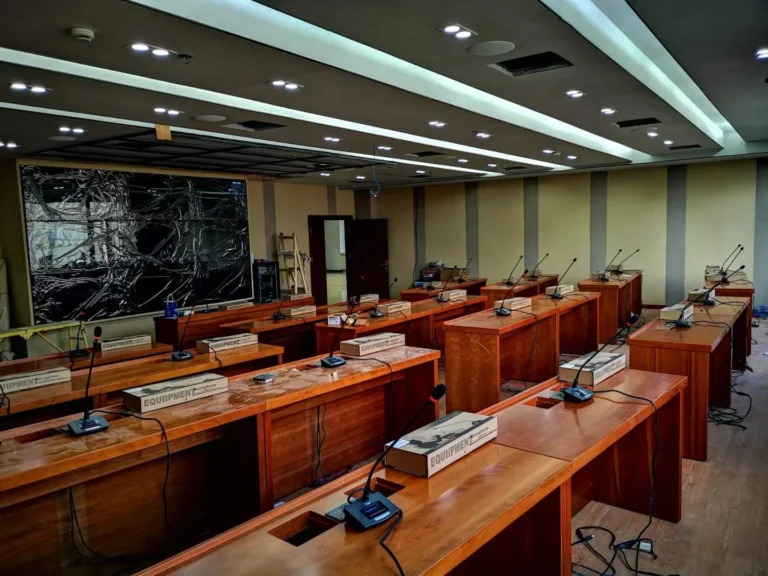
Photographs from commissioned rooms using Mils Audio amplification – all 52 installation photos →


Send the room list with sizes and whether each room divides. We will return one standard rack configuration plus the exceptions, so maintenance stays predictable.