
A touring rack fails for three reasons: a low-impedance load the amplifier cannot hold, a mains supply that delivers less than the label claims, and heat with nowhere to go. This page is about choosing the amplification so that none of the three closes a show down.
Four constraints decide the specification long before the wattage does.
Sub banks and line array sections often land at 2 Ω per channel once you stop adding amplifiers. Every FP model is rated at 2 Ω in stereo mode — the FP15000 still gives 3,000 W there.
FP uses active power factor correction, so current draw stays close to a clean sine wave. On a generator or a weak venue supply this is the difference between a rack that holds and one that trips.
Bridging is how you get real subwoofer power without doubling the chassis count: the FP15000 delivers 6,000 W into a bridged 4 Ω load, the D41350 5,160 W.
FP is 482 × 460 × 88 mm (2U). Where the rack is shallow, the X Series is 304 mm deep — and 12.5 to 35.3 kg depending on model, so plan the flight case around it.
All six series are built in the same factory and share the same protection set. These three cover this application.
2-channel tracking Class-D with PFC: 300 W to 1,500 W per channel at 8 Ω, 2,300 W at 4 Ω, 2 Ω stable, 6,000 W bridged. The default choice for FOH and sub racks.
Compact 2- and 4-channel Class-D at 400–1,000 W per channel, with selectable 0.775 V / 1 V / 32 dB input — useful in monitor world where the console is already gain-staged.
Toroidal-transformer Class-D, 482 × 304 mm footprint, up to 2,000 W per channel and 7,500 W bridged into 4 Ω — for shallow racks and heavy low-end duty.
Comparing all six ranges side by side? Series comparison table →
Six channels of subs, four of tops, four monitors — ten rack units. Every figure below is a published rating from the series tables, not an estimate.
| Position | Amplifier | Mode | Output |
|---|---|---|---|
| Sub L + R | 2 × FP15000 | bridged 4 Ω | 2 × 6,000 W |
| Top low-mid | FP10000 | stereo 4 Ω | 2 × 1,500 W |
| Top high | FP4000 | stereo 8 Ω | 2 × 400 W |
| Monitors | DAI404 | 4 ch, 8 Ω | 4 × 400 W |
Ten units of rack space including the two sub amplifiers. If the site is on a generator, budget the mains for the bridged sub pair first — it dominates the current draw at the bottom of the show.
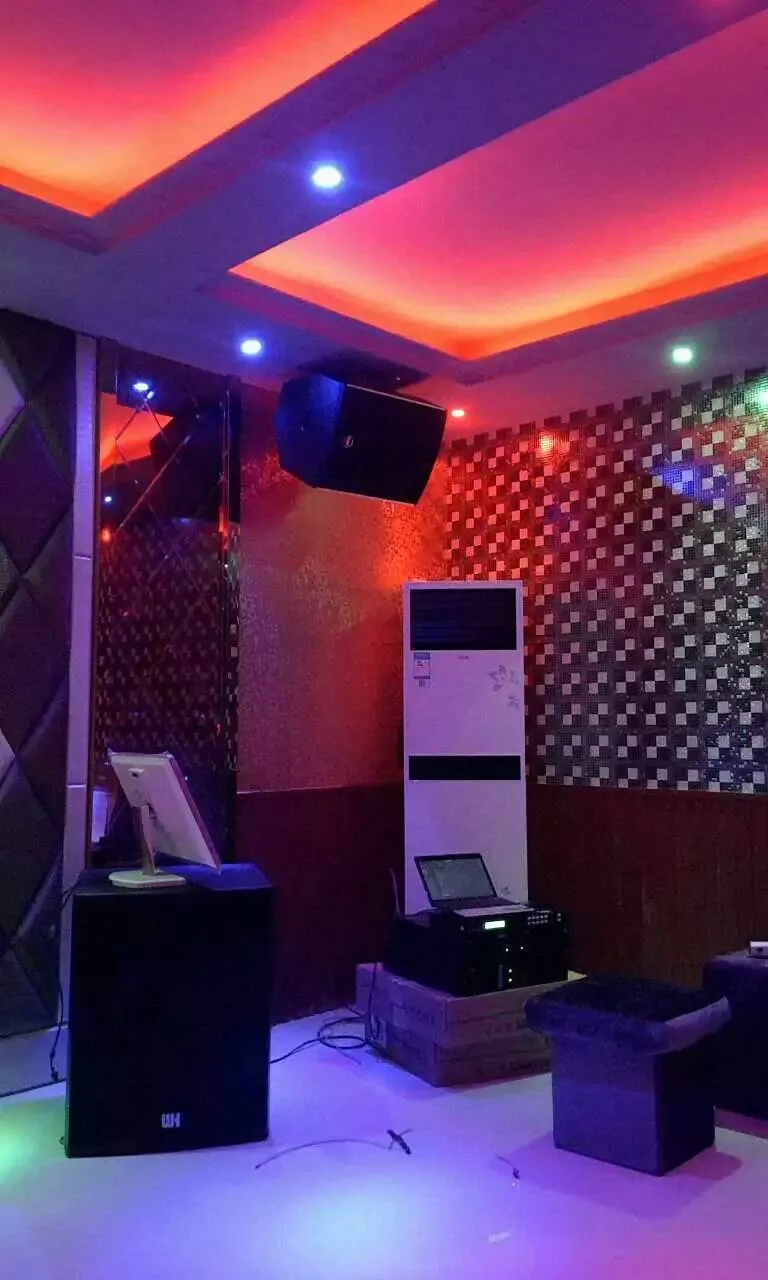
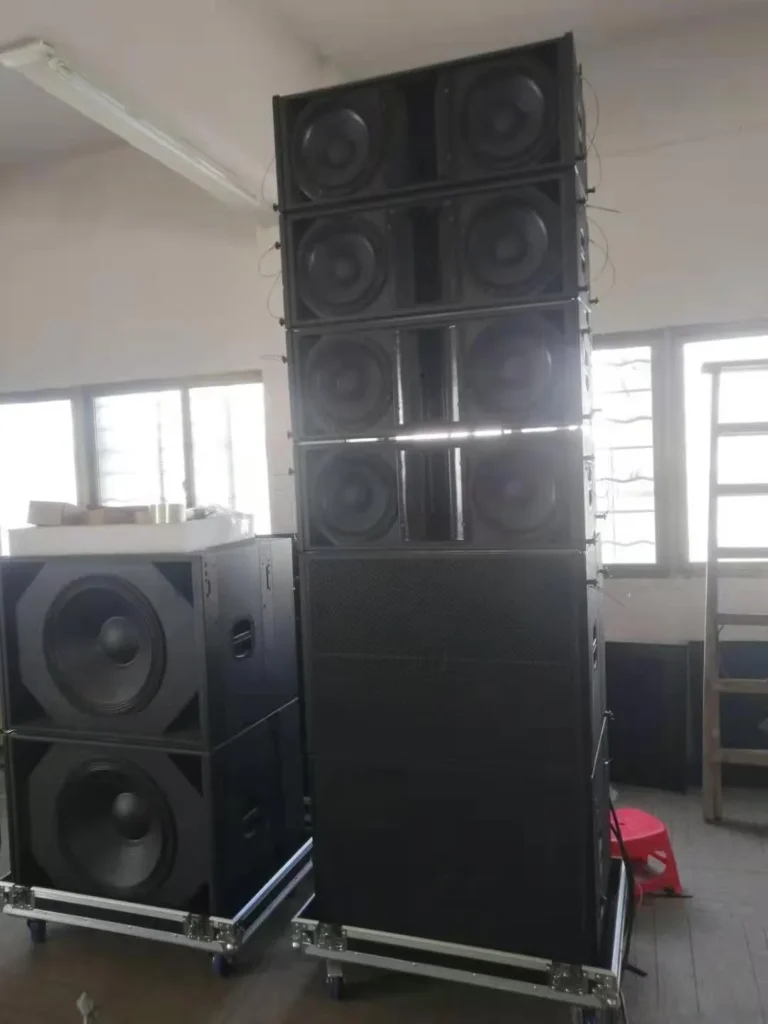
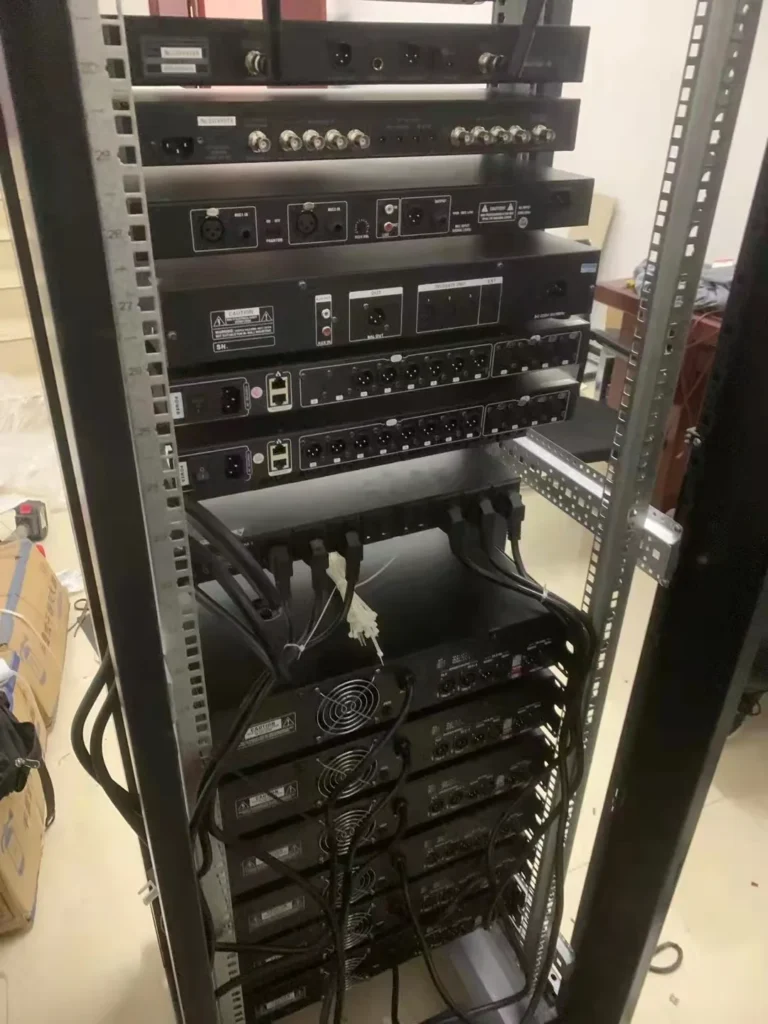
Photographs from commissioned rooms using Mils Audio amplification – all 52 installation photos →
We will come back with a channel plan, the bridged and stereo figures that apply, and a rack layout you can build from.